Generative design in architecture: rules, goals and a search for options
Generative design is a method in which the designer sets out rules that produce designs, along with measurable goals and limits, and software generates and scores many options. Form finding is a related approach in which forces such as gravity shape the geometry. In both cases the designer still chooses which result to develop.
How generative design works: rules, goals and search
Generative design in architecture starts from a generator and a way to score what it makes. The generator, usually a parametric model of the building, turns a set of input values into a design. Objectives are numbers to minimise or maximise, such as annual cooling load or the number of different parts a CNC machine cuts. Constraints are limits every acceptable option must meet, such as a height limit or a minimum floor area.
The set of all designs the generator can make is the design space, and it grows fast. Ten parameters with ten possible values each give ten billion combinations, far too many to simulate one by one when a single daylight run takes minutes. Search algorithms look for good regions of that space without visiting all of it.
Genetic algorithms in plain words
A genetic algorithm treats each option as a genome: the list of its parameter values. It starts with a random population, scores every member, keeps the better ones and breeds new options by mixing their values (crossover) and changing a few at random (mutation). Over many generations the population drifts towards higher scores.
Nothing guarantees the best possible design. The search can settle on a local optimum, and runs from different random starts may end in different places, so running it more than once is a basic check.
Multi-objective optimisation and the Pareto front
Real goals conflict. More glass brings daylight and also heat; a lighter structure deflects more. A multi-objective search keeps every option that cannot be improved on one goal without getting worse on another. Together these options form the Pareto front, and plotting it shows the trade-off the team has to settle.
Optimisers also exploit gaps in the brief. Ask for the lowest solar gain alone and the search returns a building with almost no windows. Teams add a daylight metric as a second goal or set a minimum as a constraint, and they inspect the winning options by eye before trusting the scores.
Physical form finding: hanging chains and soap films
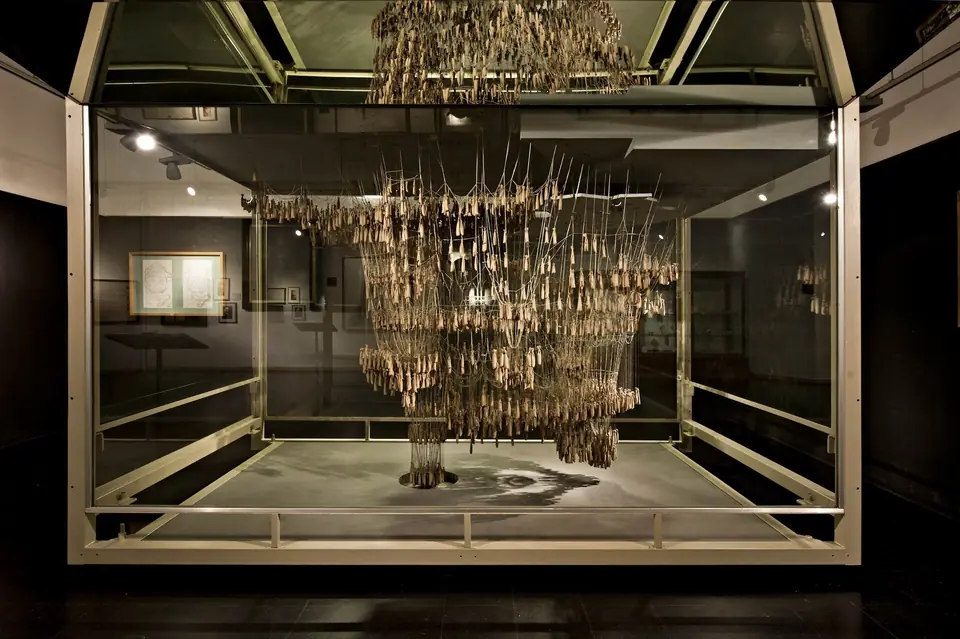
Long before computers, designers let forces find shapes. A chain hanging under its own weight takes a curve in pure tension; turned upside down, the same curve gives an arch in pure compression under that load. Loaded nets of chains found vaults and shells the same way.
A soap film stretched across a wire frame settles into a minimal surface: no nearby shape spanning that frame has less area, and the tension is equal everywhere. Tensile membrane roofs use similar shapes, because a prestressed fabric curved in two opposite directions stays taut under wind.
Digital form finding and why the designer still chooses
Software now does the same job with a network of nodes joined by bars or springs. Dynamic relaxation applies loads and lets the network settle step by step, and Kangaroo brings this kind of solver into Grasshopper. The force density method reaches an equilibrium shape for such a network in one linear solve. The shape found is right only for the load it was found under, so a structural check with snow and wind always follows.
No score captures everything a building must do. Cost, planning rules, how a space feels and what the client wants rarely fit into a fitness function, so the designer reads the front, discards options that fail on unstated grounds and records each reason as a new constraint for the next run.
Worked exampleForm finding a timber gridshell for a market hall
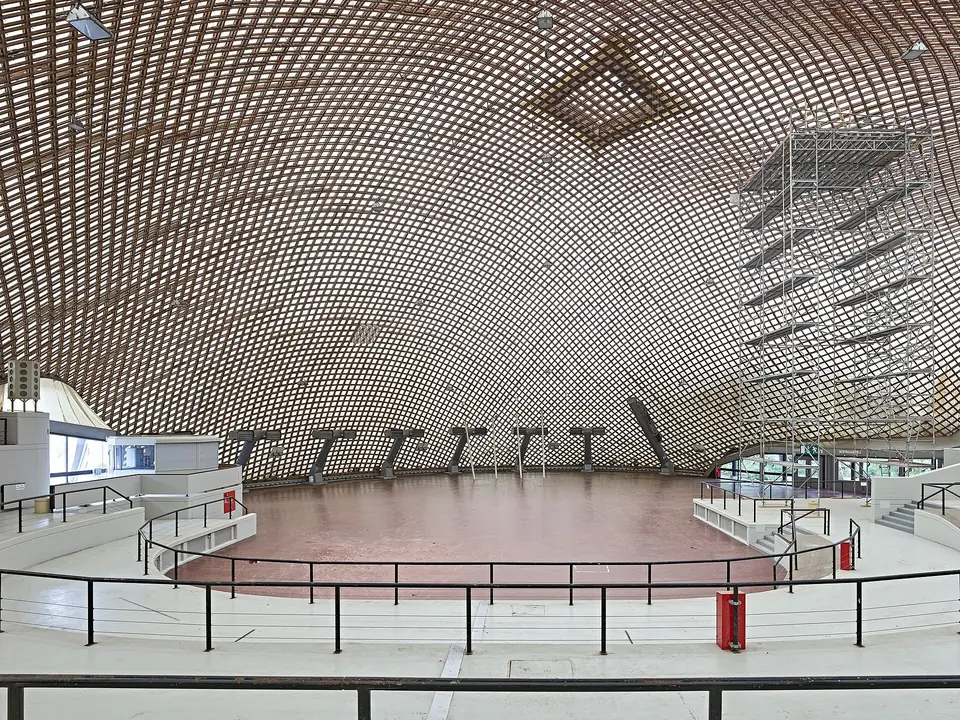
Hypothetical project. A covered market needs a light roof over a rectangular plan, supported only along its edges and built as a gridshell of timber laths.
- 01
A digital net of equal-length links is pinned along the edges and loaded with its own weight in Kangaroo. Equal links matter, because a mat of straight laths can only bend into shapes where the spacing along each lath stays the same.
- 02
The settled net is flipped upside down, giving a shape that works mainly in compression under its own weight.
- 03
Karamba3D checks that shape under snow on one half and under wind, which the hanging model ignored, and reports deflections.
- 04
A multi-objective search varies edge heights and grid spacing to reduce deflection and total lath length. Options whose low edges would block stall awnings are rejected, and a minimum edge height becomes a constraint.
- 05
The search runs again, the team picks one shape from the new front, and lath lengths and node positions go to the workshop.
Where it falls short
- A search only explores the design space its generator can produce. A good idea outside that space never appears, however long the run.
- Each evaluation costs time. With detailed daylight or energy simulation a large search can take days, so teams often search with coarse models and check finalists in detail.
- Scores are only as good as the models behind them, and an optimiser will exploit any weakness, such as a daylight model that ignores glare.
Key terms
- Design space
- All the designs a generator can produce from the allowed ranges of its parameters.
- Fitness function
- The calculation that turns an option into a score the search tries to improve.
- Pareto front
- The set of options that cannot be improved on one objective without getting worse on another.
- Genetic algorithm
- A search method that breeds new options from the best-scoring ones, using crossover and random mutation, over many generations.
- Dynamic relaxation
- A numerical method that finds an equilibrium shape by letting a network of nodes and springs move under load until it settles.
- Minimal surface
- A surface with locally the least area for its boundary, as formed by a soap film, with equal tension in every direction.
Questions
Does generative design replace the architect?
No. The architect sets the rules and goals and decides between the results, often for reasons no score captures. The software takes over the repetitive part of trying and measuring many options.
What is the difference between optimisation and form finding?
Optimisation searches through options and scores them against goals. Form finding computes a shape in equilibrium with a given set of forces, such as a hanging net under its own weight. Many projects use form finding for a base shape and optimisation to tune its parameters.
Can generative design be used for floor plans?
Yes. Layout studies place rooms or desks by rule and score each option for walking distance or daylight. The scores need careful definition, because a plan that wins on paper can still fail in ways only people notice.