Kinetic facade: how moving shading works and what drives it
A kinetic facade is a building envelope with parts that move to change how much sun, light, air or view passes through. Louvres rotate and panels fold or slide, driven either by motors that follow sensors and control rules or by materials that bend by themselves as temperature or humidity changes.
What moves on a kinetic facade
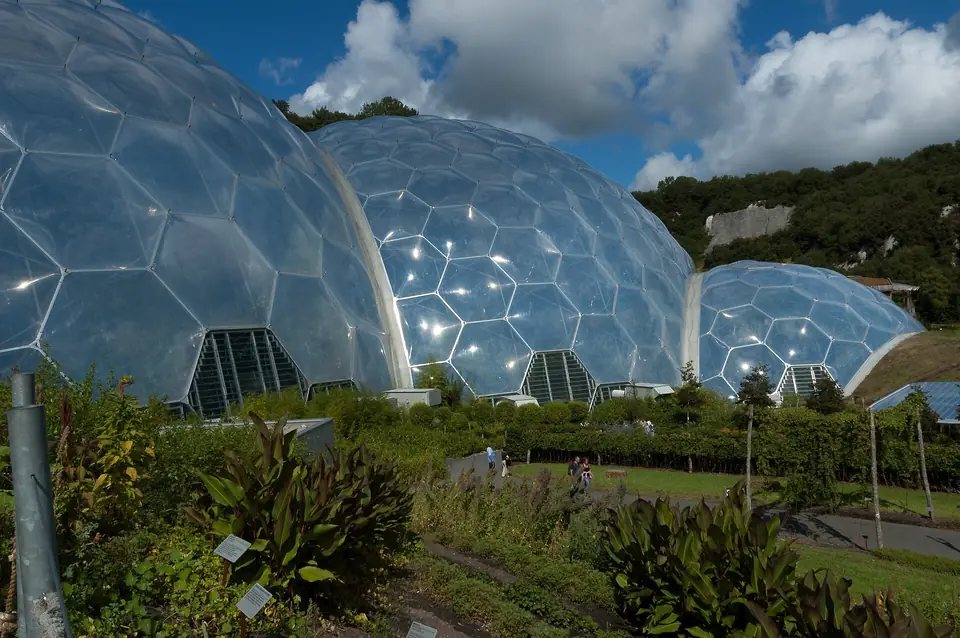
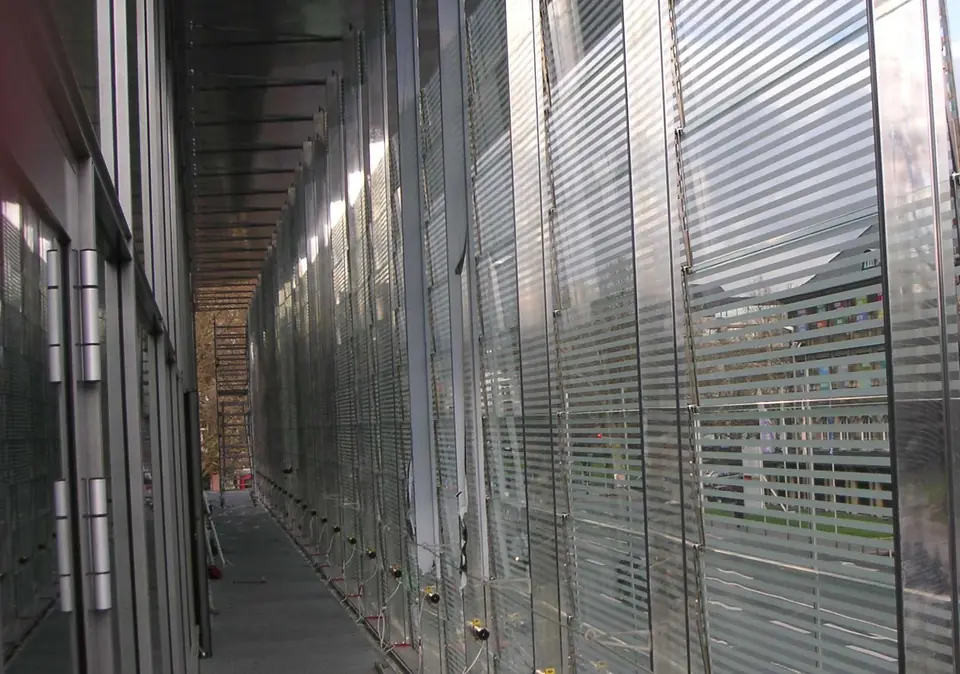
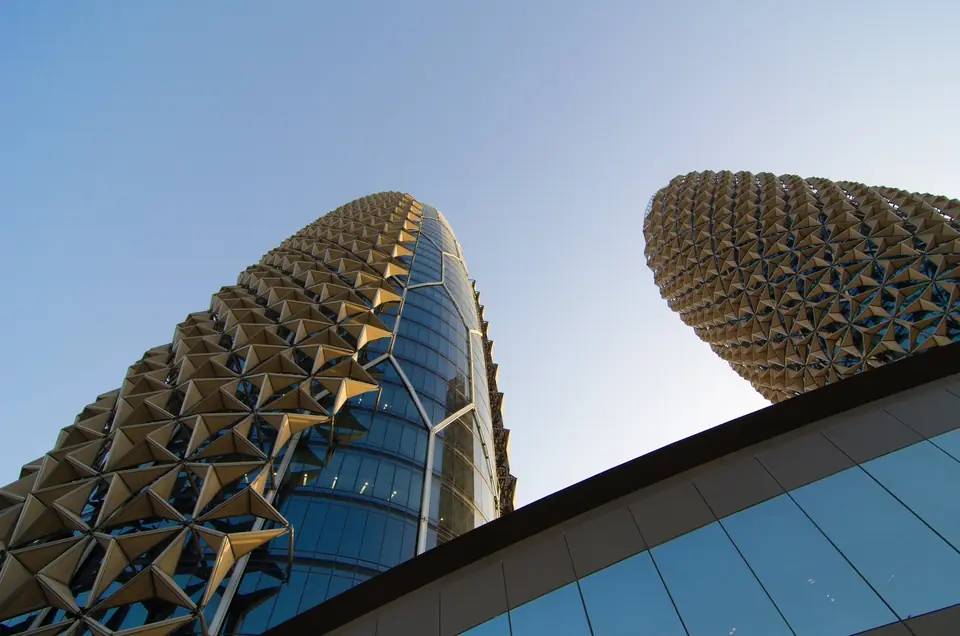
Most moving facades are shading. External louvres rotate about their long axis, vertical fins turn to follow the sun, and perforated panels fold like a concertina or slide along a track. ETFE foil cushions can shade too: air pressure pushes a printed middle layer against a printed outer one, and the two patterns combine into a denser screen.
Each extra movement adds bearings and seals, and gaps that rain and grit will find. A louvre that only rotates is far easier to seal than a panel that rotates and slides, which is one reason rotating louvres are so common.
What drives the movement
Active systems use actuators: electric motors turning a shaft or extending a linear actuator, or hydraulic rams for heavy panels. One motor often drives a row of louvres through linked arms, which keeps them aligned, though a single jam then stops the row.
Passive systems change shape on their own, with no power or wiring. The humidity-driven version borrows how a pine cone opens: a thin wood veneer bonded to a stable layer bends as it takes up or loses moisture. Other passive drives:
- Shape-memory alloys such as nickel-titanium, which return to a trained shape when warmed past a transition temperature.
- Thermobimetals: two bonded metal sheets that expand at different rates, so the strip curls as it heats up.
- Wax actuators like those in greenhouse vent openers, where melting wax expands and pushes a piston.
How a kinetic facade is controlled
Control usually comes down to a few rules. Sun position is calculated from the date, time and site coordinates, so louvres can track the sun without a sensor. A roof sensor decides whether the sky is bright enough to need shading. A wind sensor overrides everything and parks external parts above a set wind speed. Occupants get a local override that expires after a fixed time.
The classic failure is hunting: on a day of broken cloud a single threshold opens and closes the louvres every few minutes, which is noisy and wears the motors. The standard fixes are hysteresis, where shading closes above one value and opens only below a lower one, and a delay before any move. A related failure is a roof sensor shaded by a plant room, so a whole elevation reacts to a shadow.
Prototyping with microcontrollers
Prototypes of a kinetic facade usually start at desk size, with a microcontroller board such as an Arduino, small servo motors and light sensors. Plug-ins for Grasshopper stream sensor readings into a parametric facade model and send angles back, so the screen model and the card panel move together.
A desk prototype tests logic and hides the hard parts. A servo turning a card louvre says nothing about the torque needed to hold a full-size aluminium blade in a gust, or how a pivot behaves after years of grit and frost. A full-size mock-up of one bay comes next, cycled many times and tested for water tightness both open and closed.
Wind, wear and maintenance
Wind load and pivot torque change with blade angle, so engineers check every position a blade can take. The facade also needs a fail-safe position for loss of power, agreed with the fire engineer, because a closed screen can block smoke vents or rescue access. Motors should be replaceable from a reachable place, and logging each unit's faults, as a live building model can, shows which ones are wearing out.
Worked exampleRotating fins on a west-facing office wall
Hypothetical project. A four-storey office has a fully glazed west facade. Low afternoon sun brings glare and overheating, and the client wants to keep the view when the sun is off the glass.
- 01
Fixed vertical fins are tested in a daylight model. No single angle blocks the low sun all afternoon and still keeps the view.
- 02
The fins are made to rotate in zones of a few bays per floor, each zone driven by one motor through a linkage.
- 03
Rules are set: track the sun under a bright sky, turn the fins square to the glass in dull weather, park them in high wind and allow a two-hour override from a wall switch.
- 04
A desk prototype shows the fins hunting in broken cloud, so hysteresis and a delay are added before full-size work.
- 05
A full-size bay is cycled in wind and rain. Grit in the lower pivot leads to a covered bearing detail, and the handover records the fail-safe position and every motor's location.
Where it falls short
- Every moving part needs inspection and replacement over the building's life; where the sun's path is predictable, a well-designed fixed shade is often the sounder choice.
- Passive materials react to local temperature or humidity whether or not anyone is in the room, and occupants cannot override them.
- Movement and motor noise can distract people near the glass, so slow, infrequent moves tend to suit occupants better than tracking every change in the sky.
Key terms
- Actuator
- The device that produces movement on a facade, such as an electric motor, a linear actuator, a hydraulic ram or a wax piston.
- Shape-memory alloy
- A metal, typically nickel-titanium, that returns to a trained shape when heated past its transition temperature, so it can move a part without a motor.
- Thermobimetal
- Two metal sheets with different thermal expansion bonded together. The strip curls as its temperature changes.
- Hysteresis
- A control rule with two thresholds, one for closing and a lower one for opening, so a facade does not switch back and forth around a single value.
- Hunting
- Repeated opening and closing of a facade as conditions hover around a threshold, typically on days of broken cloud.
- Fail-safe position
- The position moving parts go to, or stay in, when power or control fails. It is agreed with the fire engineer at design stage.
Questions
What is the difference between a kinetic and a responsive facade?
Kinetic describes any facade with moving parts, including panels moved by hand or on a timetable. Responsive usually means the facade changes by itself in reaction to measured conditions such as sun or temperature. Adaptive facade is usually the broader term and also covers switchable glass that changes tint with no moving parts.
Do kinetic facades save energy?
They can reduce cooling loads and glare compared with unshaded glass. Whether they beat good fixed shading depends on climate, orientation, control rules and maintenance, so a fair simulation compares them with a well-designed fixed option. A facade whose motors have failed behaves like a fixed screen stuck in whatever position it stopped.
What happens to a kinetic facade in a power cut?
It should move to, or stay in, a fail-safe position chosen at design stage. Some systems use battery backup or a spring return to reach that position. The choice is agreed with the fire engineer, because shading that stays closed can block smoke vents or access for rescue.